Background jobs
Bower schedules recurring maintenance and health-reporting work with a small
in-process cron scheduler (Bower.Jobs: RecurringJobRegistry and a
PeriodicTimer-driven hosted service). Event delivery is not a scheduled job.
The scheduler replaced Hangfire so every host publishes as Native AOT; the jobs,
ids and UTC schedules are unchanged.
What runs where
| Host | Job id | Schedule (UTC) | What it does |
|---|---|---|---|
| Collector | queue-retention | Hourly | Deletes delivered rows older than BOWER_QUEUE_RETENTION_HOURS (default 168). Never touches queued, uploading, retrying or dead-lettered events. |
| Collector | queue-maintenance | Daily 03:00 | PRAGMA wal_checkpoint(TRUNCATE) and PRAGMA optimize on the queue database. |
| Collector | management-heartbeat | Every minute | Registers the collector and reports queue, output and job health (heartbeat v2). Verifies signed commands in the response and hands them to the hosted command worker; never runs them itself. With BOWER_MANAGEMENT_AUTH=enrolment it first exchanges a new enrolment token and afterwards rotates the credential when it is due. Only when BOWER_MANAGEMENT_ENDPOINT is set. |
| Collector | source-activity | Every minute | Saves per-application last-seen times to the queue database so source silence detection survives restarts. Metadata only. |
| Collector | queue-archive | Every minute | Copies newly stored events into the verifiable archive. Only when BOWER_ARCHIVE_PATH is set; reads the queue, never changes event state. |
| Management API | collector-staleness | Every 5 minutes | Marks approved/active collectors that have not reported for 15 minutes as stale and writes one collector.stale audit row per transition. Also expires overdue collector commands (collector.command-expired) for collectors that are offline, suspended or heartbeating v1. |
| Management API | collector-inactivity | Daily 02:00 | Suspends collector identities that have not reported for BOWER_COLLECTOR_INACTIVE_DAYS (default 30). |
Schedules are five-field cron expressions evaluated in UTC (*, values, ranges,
steps and lists). A job never overlaps itself; occurrences missed while a run was in
progress or the process was stopped are coalesced into one run, never replayed.
Failed runs are retried with a 15 s, 30 s, 60 s … (capped at 10 minutes) delay up to
the job's retry count: queue-retention 3, queue-maintenance 2,
collector-staleness 2, collector-inactivity 2, and
management-heartbeat, source-activity and queue-archive 0 (the next minute's
run supersedes a failed one).
With an archive configured, queue-retention purges only events covered by a verified
archive of this queue (segments present, digests and chain intact, starting at or below
the oldest stored event, chain equal to the queue ledger). Otherwise it purges nothing
and logs a metadata-only warning (event 1202) with the reason, so a stalled or damaged
archive delays purging rather than losing events. queue-archive holds the archive
writer lock for each run; a run that finds the lock held fails and the next minute's run
retries.
Management commands are not run by a scheduled job either. A run-canary queues an
event, so the hosted ManagementCommandWorker runs every admitted command.
Closing suppression windows is not a scheduled job: it queues summary events,
which is queue state, so it runs in the hosted SuppressionWindowWorker loop every
5 seconds beside the delivery worker.
Why delivery stays out of the scheduler
Delivery needs sub-second latency and exactly-once settlement of each leased
event. The SQLite queue already provides durable leases, retry times and
acknowledgements, so the hosted QueueDeliveryWorker drains it directly. Putting
delivery in a scheduler would add a second source of truth for event state and
weaken the "never delete before acknowledgement" invariant.
Why in-memory storage
Every job is idempotent and derives its work from Bower's own SQLite stores. If a process restarts, the schedule is rebuilt at start-up and the next run picks up where the last left off. This avoids a second database just for scheduling. Only the last run time and state per job are kept, in memory, and are lost on restart; job outcomes that matter (stale collectors, retention) are recorded in Bower's audit trail or queue state.
With several management API replicas, each replica runs its own staleness sweep.
The sweep is idempotent (it only changes collectors not already stale), so
duplicate runs write no extra audit rows.
Observing jobs
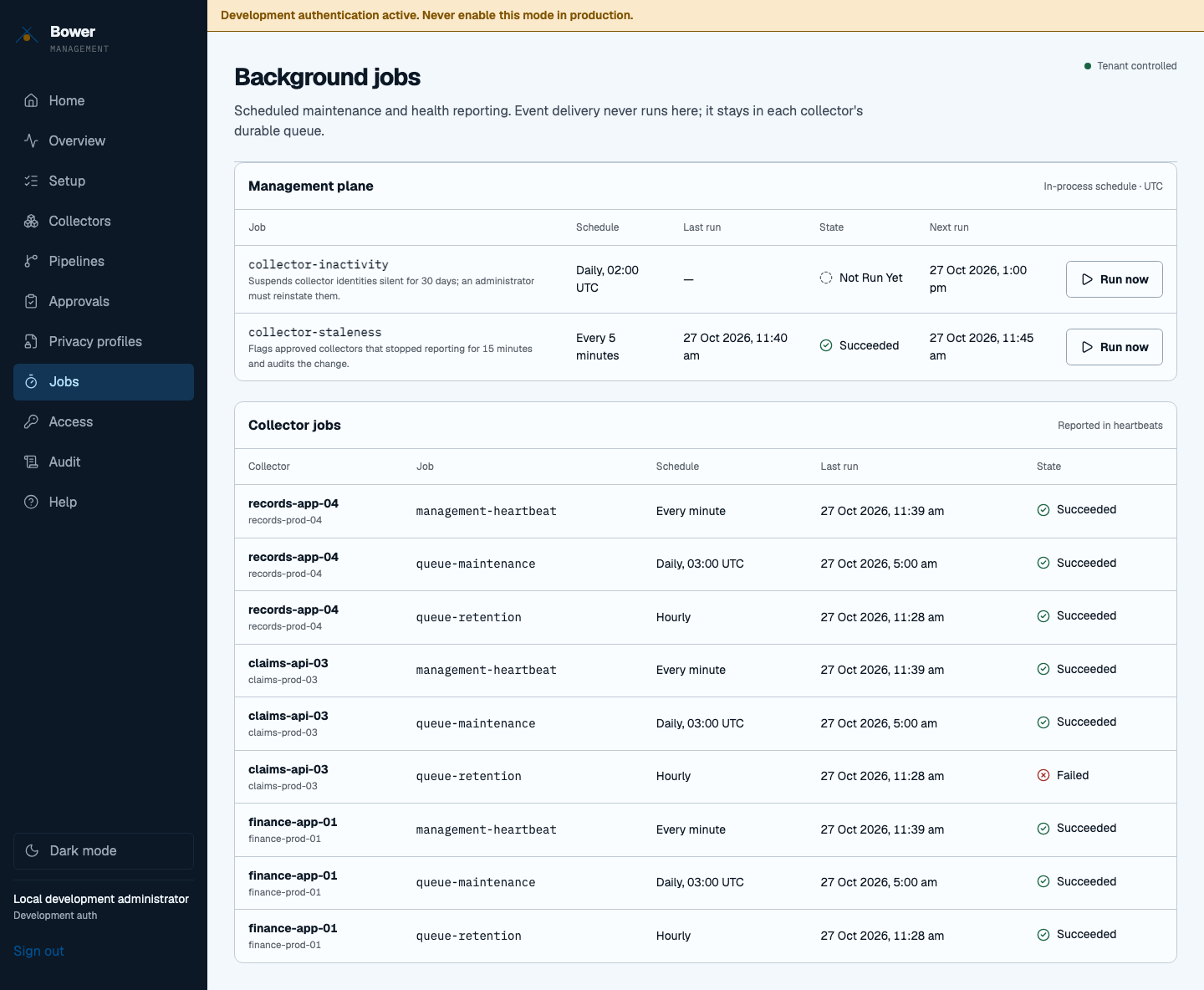
- Console: Jobs lists management jobs (with Run now for
Bower.Administrator) and every collector's reported jobs. - Management API:
GET /api/jobs(Viewpolicy) andPOST /api/jobs/{id}/trigger(Administerpolicy, audited asjob.triggered). - Collector:
GET /v1/statuswith the ingest token returns queue counts and job states. The fields are read at slightly different moments: for a short time after a failed delivery,lastFailureCodecan name the failure while the queue counts still show the event as uploading. Read the status again rather than treat one response as a consistent snapshot.
There is no scheduler dashboard: the management API uses bearer tokens only, and a dashboard would add a cookie-authenticated surface. Job status is metadata only — no arguments, payloads or exception text. A failed attempt logs the job id, attempt and exception type only.
Adding a job
- Add a class with a
RunAsync(CancellationToken)method under the host'sJobs/folder. Keep it idempotent and argument-free. - Register it with DI and with
RecurringJobRegistry.AddOrUpdate<TJob>(id, (job, token) => job.RunAsync(token), cron, retryAttempts)in the host'sInitializeAsync. Schedules are UTC; useCron.Hourly(),Cron.Daily(hour)or a five-field expression. - Choose
retryAttemptsdeliberately (reporting jobs use 0). Overlap protection is built in. Keep the job reflection-free (Native AOT). - Add a description in
ui/Bower.Management.Web/src/pages/JobsPage.tsxand a test.