Local development with Aspire
src/Bower.AppHost is an Aspire AppHost that starts a working Bower
pipeline on your machine with one command: collectors, the management API, the Azure
Functions collector and local stand-in destinations, all visible in the Aspire dashboard
(resources, console logs, structured logs, traces and metrics).
It is a local development and integration-test harness only. It is never published,
packaged or deployed. Production stays on the existing paths: deploy/docker (Compose),
deploy/bicep, deploy/azure-function, deploy/azure-webapp and the native packages.
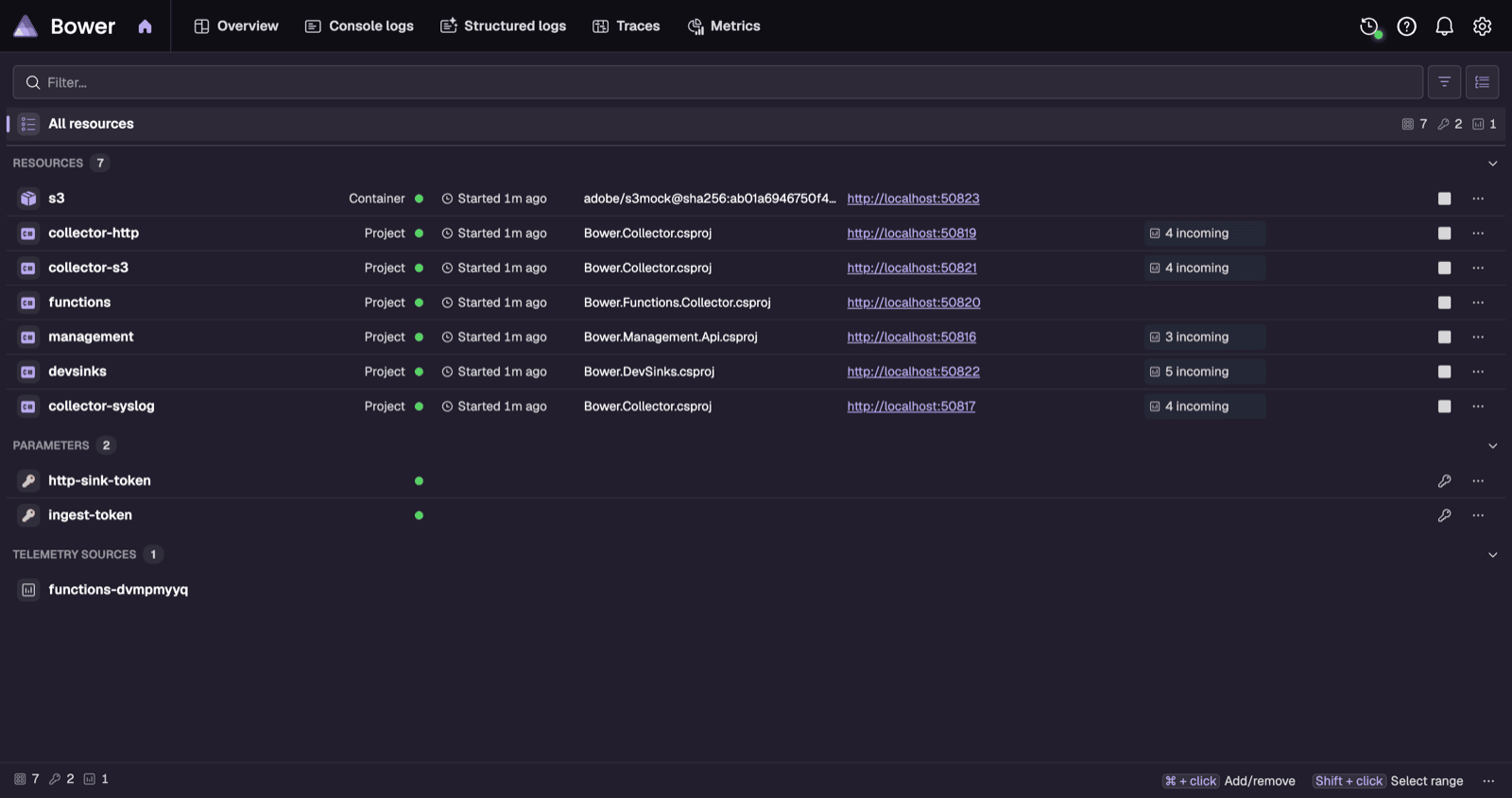
What it runs
| Resource | What it is | Exercises |
|---|---|---|
collector-s3 | Bower.Collector, BOWER_OUTPUT=s3 | Bower.Output.S3 against the s3 emulator |
collector-http | Bower.Collector, BOWER_OUTPUT=http, BOWER_HTTP_FORMAT=ndjson | Bower.Output.Http against devsinks (/ndjson, bearer token, loopback HTTP) |
collector-syslog | Bower.Collector, BOWER_OUTPUT=ama-syslog (Linux and macOS only) | Bower.Output.AmaSyslog against a Unix datagram socket bound by devsinks in place of rsyslog and Azure Monitor Agent |
functions | Bower.Functions.Collector under Azure Functions Core Tools, BOWER_DEVELOPMENT_AUTH=true | Function host start-up, /health, /v1/status, request validation and policy |
management | Bower.Management.Api, BOWER_AUTH_MODE=development | Fleet API and its health route |
s3 | adobe/s3mock 5.2.3 container, pinned by digest | S3-compatible bucket bower-aspire |
devsinks | tools/Bower.DevSinks | NDJSON endpoint, syslog socket and a read-only view of what each destination received |
Each collector has its own queue under artifacts/aspire/<resource>/, an ingest token
generated on first run and stored in the AppHost user secrets (parameter ingest-token),
and exact producer scopes for the canary event only (BOWER_PRODUCER_SCOPES_JSON). No
collector uses BOWER_SINGLE_TRUST_DOMAIN or unauthenticated ingest.
Bower.Jobs is not a resource: it is the in-process scheduler library each host already
runs, not a separate process.
What cannot be emulated
- Azure Logs Ingestion (
BOWER_OUTPUT=azure-logs-ingestion, and the Functions collector's only output). There is no Microsoft emulator; it needs a real data collection endpoint, rule and Entra token. Thefunctionsresource points at the unreachable placeholderhttps://logs-ingestion.invalid, so/v1/eventsanswers503("Destination did not accept the event") after policy and redaction succeed. Test real delivery with the Azure Functions guide or the AWS validation lab. - Azure Monitor Agent behind
ama-syslogandama-spool: the harness proves Bower wrote a correct frame, not that AMA forwarded it. - Entra authentication for the management API and the Functions collector: both run in their explicit, Development-only bypass modes, which they refuse outside Development.
- Windows Event Log and other OS sources are not wired here.
The Functions host needs no storage (HTTP triggers only), so no Azurite container runs.
Nothing here proves Sentinel delivery. Canary output proves local receipt, policy acceptance and delivery to a stand-in.
Prerequisites
- .NET SDK
11.0.100(pinned inglobal.json; Aspire 17 supports it withrollForward: disable). - A container runtime. On a workstation, name the Docker context:
export DOCKER_CONTEXT=orbstack(ordesktop-linux). - Azure Functions Core Tools
v4 (
func) for thefunctionsresource. - Optional: the Aspire CLI (
aspire). The first build of the AppHost fetches the matching CLI bundle (orchestrator and dashboard, about 170 MB) from nuget.org.
If dotnet lives in ~/.dotnet, export DOTNET_ROOT=$HOME/.dotnet so the AppHost and
the services find the .NET 11 runtime.
Run it
export DOCKER_CONTEXT=orbstack
aspire run --apphost src/Bower.AppHost -lp http
# or, without the Aspire CLI:
dotnet run --project src/Bower.AppHost --launch-profile http
The dashboard opens at http://localhost:15319 (the login URL with its token is printed
on start-up). The http profile serves the dashboard over plain HTTP on loopback, so no
development certificate has to be trusted. The aspire run start-up warning about
untrusted developer certificates is expected with this profile.
Send an event through
Each collector has a Send canary command (resource menu … in the dashboard, or the
CLI). It posts one synthetic authentication failure that policies/default accepts:
aspire resource collector-s3 send-canary
aspire resource collector-http send-canary
aspire resource collector-syslog send-canary
aspire resource devsinks read-s3        # pull the bucket's NDJSON objects into the view
Then check what each destination received (the devsinks URL is on the resources page):
curl -s http://localhost:<devsinks-port>/api/summary
# {"received":{"http":1,"syslog":1,"s3":1}}
curl -s http://localhost:<devsinks-port>/api/s3   # the delivered, redacted envelopes
You can also send your own events with the CLI. Read the token from the dashboard
(ingest-token parameter) and use the collector's port:
BOWER_INGEST_TOKEN=<ingest-token> dotnet run --project src/Bower.Cli -- \
  test emit --endpoint http://localhost:<collector-port>
bower test emit uses application BowerCanary, which the harness's producer scopes do
not grant, so it returns 403. That is the default-deny behaviour working; use the
Send canary command or edit CanaryEvent.ProducerScopesJson for other identities.
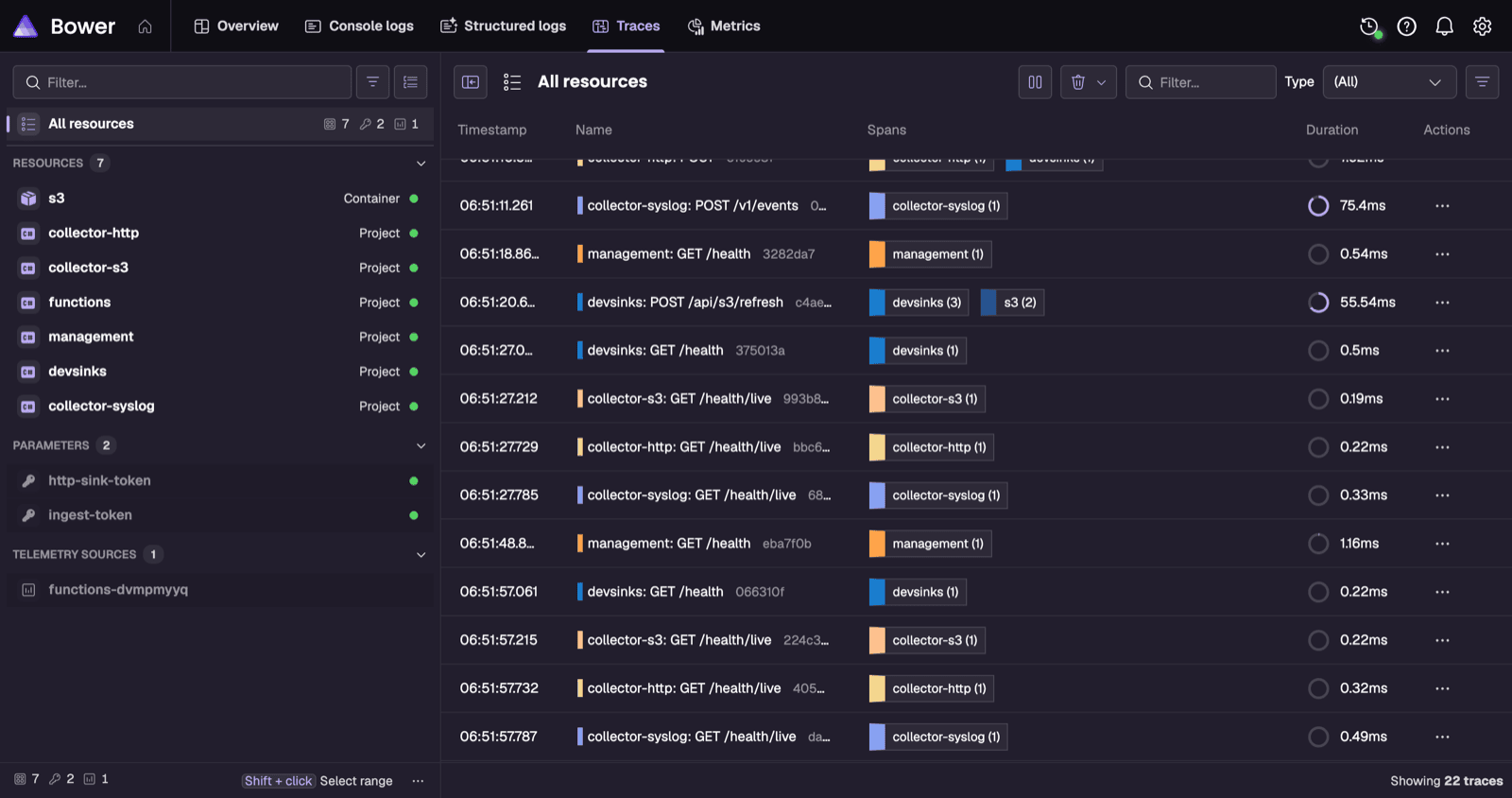
Telemetry
The hosts call AddBowerServiceDefaults() from src/Bower.ServiceDefaults. It registers
OpenTelemetry logs, metrics and traces with the OTLP exporter only when
OTEL_EXPORTER_OTLP_ENDPOINT is set, which Aspire sets for every resource and no shipped
deployment sets. Without it, nothing is registered and production behaviour is unchanged
(ServiceDefaultsTests pins this). Exported data is framework metadata (routes, status
codes, runtime and HTTP client metrics, log messages without scopes), never request or
response bodies, headers or query strings. Spans keep only allowlisted attributes (method,
route, status code, scheme, protocol version, error type), so user agents, client addresses
and full URLs are dropped. Framework request logs (Microsoft.AspNetCore,
System.Net.Http.HttpClient) reach the exporter at Warning and above only.
Generic HTTP resilience and service discovery are not applied to Bower's clients:
Bower retries through its durable queue, and the management client's single-use enrolment
token must not be retried by a generic handler. AddBowerHttpClientDefaults() exists for
a named client that explicitly opts in; no Bower client does today.
Integration test
tests/Bower.AppHost.Tests boots the AppHost with Aspire.Hosting.Testing and checks a
canary reaches the S3 emulator, the NDJSON endpoint and the syslog socket. It needs a
container runtime and the Functions Core Tools, so it is skipped unless you opt in:
DOCKER_CONTEXT=orbstack BOWER_ASPIRE_TESTS=1 \
  dotnet test --project tests/Bower.AppHost.Tests
It uses a temporary state directory and its own tokens, so it can run beside a dashboard session. CI builds the project; the test itself is skipped there. It takes about 30 seconds once images are pulled.
Clean up
Stop with Ctrl+C (or aspire stop). Containers are removed when the AppHost stops.
Queues and the management database persist in artifacts/aspire/ (git-ignored); delete
that directory for a fresh start.