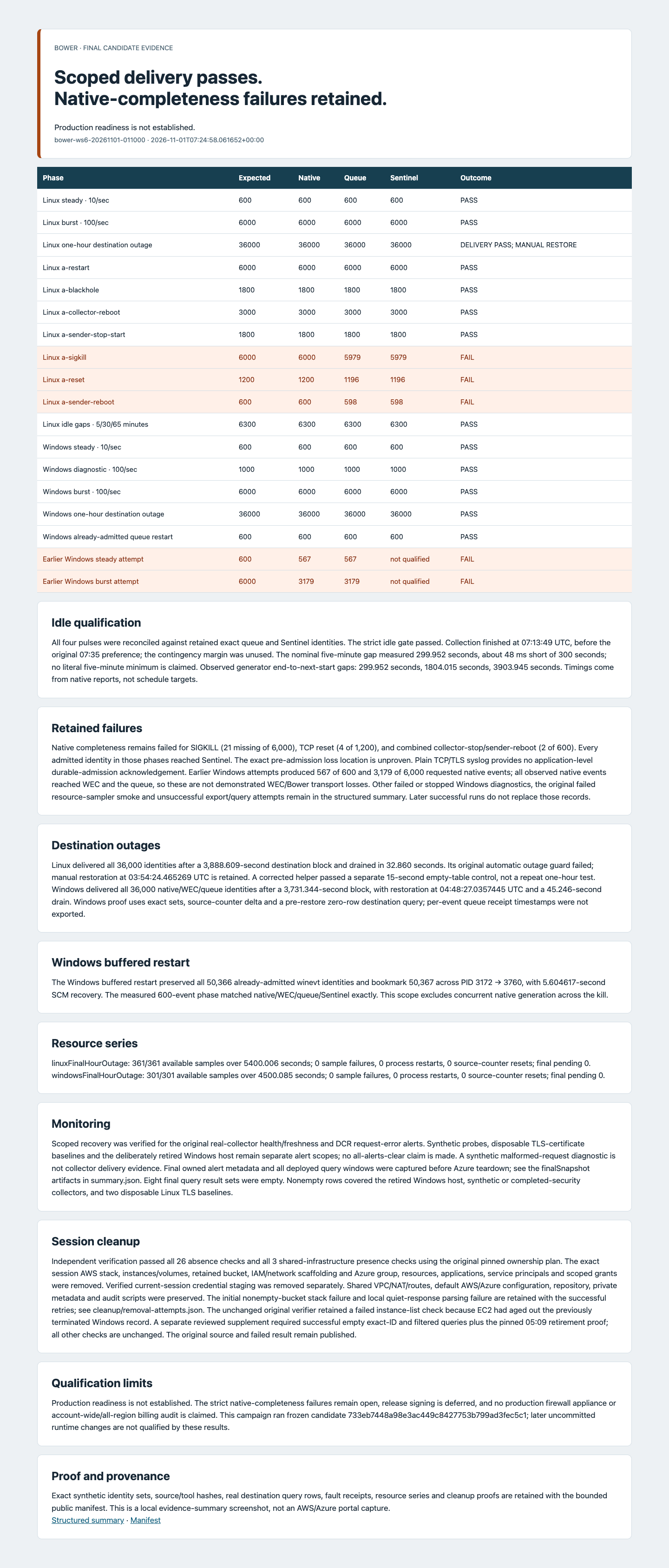
Final candidate qualification evidence
Run bower-ws6-20261101-011000. Generated 2026-11-01T07:24:58.061652+00:00.
Production readiness is not established. Exact passes apply only to their recorded scope.
| Phase | Expected | Native | Queue | Sentinel | Outcome |
|---|---|---|---|---|---|
| Linux steady · 10/sec | 600 | 600 | 600 | 600 | PASS |
| Linux burst · 100/sec | 6000 | 6000 | 6000 | 6000 | PASS |
| Linux one-hour destination outage | 36000 | 36000 | 36000 | 36000 | DELIVERY PASS; MANUAL RESTORE |
| Linux a-restart | 6000 | 6000 | 6000 | 6000 | PASS |
| Linux a-blackhole | 1800 | 1800 | 1800 | 1800 | PASS |
| Linux a-collector-reboot | 3000 | 3000 | 3000 | 3000 | PASS |
| Linux a-sender-stop-start | 1800 | 1800 | 1800 | 1800 | PASS |
| Linux a-sigkill | 6000 | 6000 | 5979 | 5979 | FAIL |
| Linux a-reset | 1200 | 1200 | 1196 | 1196 | FAIL |
| Linux a-sender-reboot | 600 | 600 | 598 | 598 | FAIL |
| Linux idle gaps · 5/30/65 minutes | 6300 | 6300 | 6300 | 6300 | PASS |
| Windows steady · 10/sec | 600 | 600 | 600 | 600 | PASS |
| Windows diagnostic · 100/sec | 1000 | 1000 | 1000 | 1000 | PASS |
| Windows burst · 100/sec | 6000 | 6000 | 6000 | 6000 | PASS |
| Windows one-hour destination outage | 36000 | 36000 | 36000 | 36000 | PASS |
| Windows already-admitted queue restart | 600 | 600 | 600 | 600 | PASS |
| Earlier Windows steady attempt | 600 | 567 | 567 | not qualified | FAIL |
| Earlier Windows burst attempt | 6000 | 3179 | 3179 | not qualified | FAIL |
Idle qualification
All four pulses were reconciled against retained exact queue and Sentinel identities. The strict idle gate passed. Collection finished at 07:13:49 UTC, before the original 07:35 preference; the contingency margin was unused. The nominal five-minute gap measured 299.952 seconds, about 48 ms short of 300 seconds; no literal five-minute minimum is claimed. Observed generator end-to-next-start gaps: 299.952 seconds, 1804.015 seconds, 3903.945 seconds. Timings come from native reports, not schedule targets.
Retained failures
Native completeness remains failed for SIGKILL (21 missing of 6,000), TCP reset (4 of 1,200), and combined collector-stop/sender-reboot (2 of 600). Every admitted identity in those phases reached Sentinel. The exact pre-admission loss location is unproven. Plain TCP/TLS syslog provides no application-level durable-admission acknowledgement. Earlier Windows attempts produced 567 of 600 and 3,179 of 6,000 requested native events; all observed native events reached WEC and the queue, so these are not demonstrated WEC/Bower transport losses. Other failed or stopped Windows diagnostics, the original failed resource-sampler smoke and unsuccessful export/query attempts remain in the structured summary. Later successful runs do not replace those records.
Destination outages
Linux delivered all 36,000 identities after a 3,888.609-second destination block and drained in 32.860 seconds. Its original automatic outage guard failed; manual restoration at 03:54:24.465269 UTC is retained. A corrected helper passed a separate 15-second empty-table control, not a repeat one-hour test. Windows delivered all 36,000 native/WEC/queue identities after a 3,731.344-second block, with restoration at 04:48:27.0357445 UTC and a 45.246-second drain. Windows proof uses exact sets, source-counter delta and a pre-restore zero-row destination query; per-event queue receipt timestamps were not exported.
Windows buffered restart
The Windows buffered restart preserved all 50,366 already-admitted winevt identities and bookmark 50,367 across PID 3172 → 3760, with 5.604617-second SCM recovery. The measured 600-event phase matched native/WEC/queue/Sentinel exactly. This scope excludes concurrent native generation across the kill.
Resource series
linuxFinalHourOutage: 361/361 available samples over 5400.006 seconds; 0 sample failures, 0 process restarts, 0 source-counter resets; final pending 0. windowsFinalHourOutage: 301/301 available samples over 4500.085 seconds; 0 sample failures, 0 process restarts, 0 source-counter resets; final pending 0.
Monitoring
Scoped recovery was verified for the original real-collector health/freshness and DCR request-error alerts. Synthetic probes, disposable TLS-certificate baselines and the deliberately retired Windows host remain separate alert scopes; no all-alerts-clear claim is made. A synthetic malformed-request diagnostic is not collector delivery evidence. Final owned alert metadata and all deployed query windows were captured before Azure teardown; see the finalSnapshot artifacts in summary.json. Eight final query result sets were empty. Nonempty rows covered the retired Windows host, synthetic or completed-security collectors, and two disposable Linux TLS baselines.
Session cleanup
Independent verification passed all 26 absence checks and all 3 shared-infrastructure presence checks using the original pinned ownership plan. The exact session AWS stack, instances/volumes, retained bucket, IAM/network scaffolding and Azure group, resources, applications, service principals and scoped grants were removed. Verified current-session credential staging was removed separately. Shared VPC/NAT/routes, default AWS/Azure configuration, repository, private metadata and audit scripts were preserved. The initial nonempty-bucket stack failure and local quiet-response parsing failure are retained with the successful retries; see cleanup/removal-attempts.json. The unchanged original verifier retained a failed instance-list check because EC2 had aged out the previously terminated Windows record. A separate reviewed supplement required successful empty exact-ID and filtered queries plus the pinned 05:09 retirement proof; all other checks are unchanged. The original source and failed result remain published.
Qualification limits
Production readiness is not established. The strict native-completeness failures remain open, release signing is deferred, and no production firewall appliance or account-wide/all-region billing audit is claimed. This campaign ran frozen candidate 733eb7448a98e3ac449c8427753b799ad3fec5c1; later uncommitted runtime changes are not qualified by these results.
Retained proof and reproduction
- Structured summary and source hashes.
- Exact identity evidence and offline verifier.
- Resource series and offline verifier.
- Actual fault execution evidence.
- Linux outage temporal proof and Windows outage temporal proof.
- Windows buffered restart proof.
- Observed idle timings and collection receipts.
- Independent cleanup proof, verifier provenance and offline checks.
- Bounded public manifest, including byte counts and SHA-256 hashes.
- Rendered report, actual local HTML screenshot, and screenshot provenance.
The screenshot is a real headless Chrome render of this local evidence summary, not an AWS/Azure portal capture. Public files contain synthetic identities, timestamps and bounded metadata, not raw event XML, payloads, queue databases or credentials. Historical per-phase cleanup flags describe their capture time; the final cleanup section records the campaign result.